Thursday, February 10, 2011

The Distracted Truth


On June 15, 2009 the Governor of Maine signed a bill titled “Failure to Maintain Control of a Motor Vehicle” (29-A Sec 2117). The law entailed that any activity not related to driving a vehicle that leads to failing to maintain control a motor vehicle illegal. 

Police officers can issue tickets under the law to any driver that committed a traffic violation or been involved in an accident while the driver was engaged in an activity that impaired the driver to safely operate the vehicle.

The bill is branch off of two other bills that came into effect in 2003 and 2007. The laws prevent drivers under the age of 18 from using cell phones and drivers that have learner’s permits or intermediate licenses.
Senator Susan Collins, R-Maine, expressed to the Bangor Daily News (BDN) that Senator Diamond’s approach is very creative and solves the problem better than proposing several bills to Congress regarding cell phones. “People can be distracted while driving by many things; I think this may be a better approach.”
Rep. George Hogan also told the BDN in response to the cell phone driving legislation that “It’s on the minds of every state, and almost every state is more aggressive than Maine.”

So the question is, is talking on a cell phone the new drunk driving?

Report from 2002-2003, the National Conference of State Legislature (NCSL) stated that the United States proposed over 100 bills concerning drivers with cell phones while operating a vehicle. New York was the first among the dozen to limit cell phone use by placing a ban on hand held phones while driving.
In August 2010 Senator Diamond is sponsoring a new bill that targets distracted drivers more specifically.

“While Maine took a big step forward passing a distracted driver law in 2009, it is clear to me now that measure deals more with the effect,” said Diamond. “The proposed ban on texting while driving I have put forward deals better with the cause of the problem.”

Since the failure to maintain control of a motor vehicle has been affect the University of Maine Police Department (UMPD) has not issued any summonses or traffic warnings. Not even one written warning.
Steve Martell, of UMPD, stated “Either everyone is behaving or not getting caught! I’m sure it’s the first” in response to there being no record of a violation on the University of Maine Campus.

Captain Josh Ewing of the Orono Police Department said that there have been only two tickets issued under 29-A Sec 2117. One in October and the other in November of 2009. None of the two were believed to been involved in accidents. “This one (bill) is still very new. I think officers are alert for the violation, and have issued summonses when they felt it was appropriate. As time goes on, I think you will see an increase in the number of summonses issued for this violation.”  

Captain Josh Ewing could not respond to what caused the two drivers to be issued tickets.
“I just don’t understand how police can enforce this law?” said Tyler Smith an UMaine Alumni. “Drive around town, you’ll see countless amounts of drivers doing things they really shouldn’t while driving. I’ve even seen a guy shaving on the highway. It’s like when you were in middle school; the teacher said no passing notes but you still did.”

In 2001 the University of North Carolina studied that revealed “cell-phone use was only responsible for 1.5 percent of distracted driving accidents.”

Lauren Weinstein, of wired.com, wrote a piece on why cell phones bans should not be passed. His reasons were that cell phones only make up a small amount of distracted driving. “We should be enforcing laws against the real problem, distracted driving in general. Cell phones make a handy technological scapegoat.”

This is what Sen. Diamond has already put in place for Maine.

Maine being one of the slowest states in enforcing cell phone use on Maine roads seems to be for good reason. Sen. Diamond is looking at the bigger picture and targeting distracted driving is turning out to be a more reasonable idea.

Bumper to Bumper Economy


The affects of the economy is playing a huge role in America and everyone has been affected in one way or another. But what about the young adults that are collecting more debt every year like it’s going out of style?
Enrolled college students are trying to hold on to getting a great education while prices continue to skyrocket. With Maine’s unemployment rate at 8.1%, finding a job is now so much harder without a college degree. How is an ambitious young adult suppose to over come the job market by going to college if they can’t afford the college price tag?
The student body at the University of Maine runs into examples constantly that are in direct relation to the poor economy. It’s the more expensive milk they drink with breakfast, it’s the over priced book resting on their desk, the over priced meals at lunch and the major example, the expensive tuition.  
Maine’s poor economy is defiantly taking a huge toll on the University of Maine and in return affecting every one of its students. For resident students that have to buy a meal plan they’re in for a 9.28% increase this school year compared to 2008. All the students have to face the 5.8% increase for in-state tuition compared to last year. Student enrollment is up but it is estimated those numbers will start to decrease due to the climbing tuition prices and many will be forced to drop out.
With prices continuing to increase students are searching for easy ways to save money; living off campus provides great solution. By living off campus students can avoid increasing room and board rates, and eating on campus where each meal can cost up to eleven dollars.
However, commuter students have to deal with one of the biggest pains on campus that will always be around; parking. It can be assumed that with more students moving off campus to save money, more are driving to school taking up more parking spaces.
It’s too early to tell if the 2010 school year will endear more parking frustration than 2009 but the student body is already talking about how much they dread fighting for parking spaces. 
  According to Lisa Haberzettl, who wrote a compelling article to the Maine Campus in 2009, parking services are giving out more permits than there are parking spaces. “For every residential parking space on campus, parking services issued 1.2 parking permits, 1.6 permits for every commuter space and 1.9 permits for every staff space”.
 To solve this problem does the University find somewhere to expand parking, or do they decrease the number of cars on campus.
The economy has managed to affect everything in a college student’s daily life from the increase food and tuition prices, to find a parking spot. The 2010 school year and years to come will defiantly unmask exactly how much it really changed college life.

Tuesday, September 28, 2010

Maine Law for All Drivers

Society is always craving the best in technology and it’s no surprise that today’s drivers have many temptations and distractions. Cell phones can do more than just make a basic call, users can now email and text message without being at a bulky computer. Yes technology has advanced so much over the years and has become affordable so the average Joe/Jane may partake in the experience.

Advancement in technology can make new addicting distractions for the user; like paying attention in class or driving a vehicle. According to a study released in January by the National Safety Council, twenty-eight percent of car accidents occur when the drivers were using their cell phones, ether talking or texting.

While other states have made it illegal for cell phone users to talk/text and drive, Maine is not one of them. Maine does have laws that prevent drivers under the age of 18 from using cell phones along with other drivers that have learner’s permits or intermediate licenses. Many users believe using a hands-free cell phone accessory, like Blue Tooth, makes driving easier but according to studies it doesn’t make a difference.
Senator Bill Diamond, D-Windham, sponsored a bill that came into effect September 12, 2009 that impacted every driver in the state of Maine. The law is met to cover a broader amount of distractions than just cell phones alone.

The law makes failure to maintain control of a vehicle illegal and is defined by a driver participating in another activity that is not necessary to driving the vehicle. Also if the activity impairs or would be assume to impair the drivers ability to drive safely. Therefore, this law covers everything from eating to talking on the cell phone.

Having a law only making cell phone usage illegal will allow new technologies legal while driving when they equally distract a driver’s attention. Senator Diamond expressed to the Bangor Daily News that targeting just cell phone usage is not the answer. “We cannot just focus on cell phones or the electronic device of the day that people are interested in at that moment,” Diamond says. “What we do is focus on the behavior, not what specifically caused it.”

The law gives police the right to ticket distracted drivers for failing to maintain control of their vehicle. If you’re using a cell phone while driving you can be pulled over if a police officer takes notice. However, if you’re using a cell phone and driving in a way that doesn’t attract attention to yourself you will go unnoticed. Making the law penalties only kick in if the driver is caught driving distracted, or is involved in an accident.

“This gives drivers a false sense of ‘I’m a great driver and will not be distracted by my cell phone.’” Seth Toothaker a senior at the University of Maine. “If it’s not illegal drivers will continue to drive and use a cell phone. People will think they can handle it, when everyone knows you cannot pay attention to the road while using a cell phone. Driving is a full time task and so many people are disrespecting this privilege.”

Rep. George Hogan told the Bangor Daily News in response to the cell phone driving legislation that “It’s on the minds of every state, and almost every state is more aggressive than Maine.”

For 2011 Sen. Diamond is sponsoring a new bill that will ban texting while driving. “While Maine took a big step forward passing a distracted driver law in 2009, it is clear to me now that measure deals more with the effect,” Diamond said. “The proposed ban on texting while driving I have put forward deals better with the cause of the problem.”

Banning texting is a great step forward to prevent innocent deaths but while technology advances Maine state laws need to keep up with the distractions Maine drivers are encountering. Until then using common sense can save hundreds of lives.

Sunday, May 2, 2010

Maine Wind Power (with pictures)

There are many environmental issues growing throughout the country and more people are trying to become eco friendly. One new idea of going greener is wind power which is a great idea to look into with Maine having the 19 highest wind resource in the United States.

A wind farm with wind turbines can provide many benefits and problems for Maine communities.

The biggest benefit to having wind power is the clean energy that is produced to replace the costly fossil fuels. Jeannie Conway of Fox Island noticed her 200 dollar electricity bill slowly decreasing since the wind farm put in November 2009. The 15 million dollar Fox Island wind farm project has three turbines that have generated 1.5 million kilowatt hours of electricity in January 2010 which exceeds many estimates. That amount of power is enough electricity to power Vinalhaven and North Haven.

One of the bigger issues with wind turbines is the appearance of them. Wind turbines are 200 to 300 ft. tall with three blades that are 65 to 130ft. long. Wind farms are most suitable in hilly areas or near the coast. This causes the wind turbine to be very visible for miles and will be seen by tourists and residents. A plus is that Maine will never have the massive wind farms like in Texas or Oklahoma due to Maine’s lack of hill and coastal area. If a huge wind farm was made Maine would be giving up its tourist income for wind income.

A not so common disadvantage to wind turbines is the noise. Residents that live near the turbines say the noise has ruined their quality of life living in Maine. In Fox Island experts told residents that the noise would be mast by other ambient sounds like wind on the ground. This isn’t the case for residents near the turbines who all live within one mile of the turbines or have a direct line of sight to them. Alan Barker lives quarter of a mile from the Fox Island wind project doesn’t mind the noise. "If you're expecting to go out and hear a pin drop that's not gonna happen," says Barker, "they do make noise and they do make more noise than you would think. But at the same time it's no different than if you live near a train or you live near a brook. This ocean out here on a stormy day makes noise."

Maine wind is a huge energy source that is slowly being tapped into. Feedback from wind farms already working in Maine will help create more energy saving wind turbines to help decrease Maine’s energy consumption.

"It is almost a perfect storm for a conflict between a desire to move toward clean energy and a desire to protect some of the few remaining wild places." -- Pete Didisheim, Natural Resources Council of Maine, advocacy director

GE Wind Energy Commercial

Thursday, April 29, 2010

Student Meeting Tuesday

ORONO, MAINE—With the school year coming to yet another end most student organizations are getting in their last few meetings. On April 27, 2010 the Student Senate had one of their last meetings and they had a pleasant surprise.

You don’t hear much about the Alumni Association as a student and probably won’t during your college career until you graduate. On Tuesdays meeting the student government met with the Alumni Association in the same room, an event that most say is the first time in UMaine history.

Todd Saucier, executive director of Alumni Association, addressed the Student Government during Tuesday’s meeting. Saucier hopes the two groups met more often and communication will stay open.

Saucier stated that the Alumni Association wants to start becoming apart of UMaine student’s lives before they become alumni. They figure becoming apart of students lives early on students will be more inclined to donate more as an alumni.

Saucier continued to address the Student Government by saying to interact with the student body early on he would like to ‘friend raise’. What this means is that the Alumni Association wants to open up communication with the student body early on and develop a friendly connection. Saucier wants students to say hello to him whether he’s walking around the mall or eating at the union.

It’s not known whether Saucier’s ‘friend raise’ will change alumni donations in the future but it’s a great start in getting all the different UMaine departments involved with each other.

Monday, April 26, 2010

Maine Wind Power

There are many environmental issues growing throughout the country and more people are trying to become eco friendly. One new idea of going greener is wind power which is a great idea to look into with Maine having the 19 highest wind resource in the United States.

A wind farm with wind turbines can provide many benefits and problems for Maine communities.

The biggest benefit to having wind power is the clean energy that is produced to replace the costly fossil fuels. Jeannie Conway of Fox Island noticed her 200 dollar electricity bill slowly decreasing since the wind farm put in November 2009. The 15 million dollar Fox Island wind farm project has three turbines that have generated 1.5 million kilowatt hours of electricity in January 2010 which exceeds many estimates. That amount of power is enough electricity to power Vinalhaven and North Haven.

One of the bigger issues with wind turbines is the appearance of them. Wind turbines are 200 to 300 ft. tall with three blades that are 65 to 130ft. long. Wind farms are most suitable in hilly areas or near the coast. This causes the wind turbine to be very visible for miles and will be seen by tourists and residents. A plus is that Maine will never have the massive wind farms like in Texas or Oklahoma due to Maine’s lack of hill and coastal area. If a huge wind farm was made Maine would be giving up its tourist income for wind income.

A not so common disadvantage to wind turbines is the noise. Residents that live near the turbines say the noise has ruined their quality of life living in Maine. In Fox Island experts told residents that the noise would be mast by other ambient sounds like wind on the ground. This isn’t the case for residents near the turbines who all live within one mile of the turbines or have a direct line of sight to them. Alan Barker lives quarter of a mile from the Fox Island wind project doesn’t mind the noise. "If you're expecting to go out and hear a pin drop that's not gonna happen," says Barker, "they do make noise and they do make more noise than you would think. But at the same time it's no different than if you live near a train or you live near a brook. This ocean out here on a stormy day makes noise."

Maine wind is a huge energy source that is slowly being tapped into. Feedback from wind farms already working in Maine will help create more energy saving wind turbines to help decrease Maine’s energy consumption.

"It is almost a perfect storm for a conflict between a desire to move toward clean energy and a desire to protect some of the few remaining wild places."

-- Pete Didisheim, Natural Resources Council of Maine, advocacy director

Tuesday, April 20, 2010

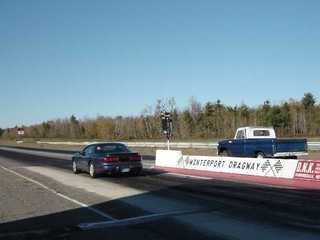
Winterport Dragway Opening Day


12.1

WINTERPORT, MAINE—Winterport Dragway announced that it will be opening its gates and 1/8 mile track on April 25, 2010. A day many car enthusiasts have been looking forward to since the close of last season late October 2009. Now that the weather is warming up and those snowy days are long gone Winterport Dragway is ready for business.

On opening day Winterport will be hosting gamblers race which is also a non points day. A “gamblers race” is when competitors pay a fixed amount (usually ten dollars) to be added to the pot. First place receives 70 percent of the pot while the runner up receivers 30 percent.

Gates open at 8:00 am and then time trails will start at 8:30 am to noon. Elimination rounds will begin at 12:30 pm. Admissions are twelve dollars for racers and spectators, race entry fee ten dollars, junior (ages 13-15) five dollars and children twelve years old and under are free. Breakfast and Lunch will be served by Deb’s Variety Snack Bar.

Another event to look forward to is on Mother’s Day May 9, 2010. Winterport Dragway will host ladies day. In addition to racing in a regular bracket program, ladies can also enter a special race for ladies only. Start times and admission prices are the same as opening day.

Winterport Dragway is available for races in the following classes; super pro eliminator, pro eliminator, motorcycles & snowmobiles, pro street, import/sport compact, Jr. dragster, ATV/Quad, and lawn mower.

For rules and/or more information visit www.winterportdragway.com or contact Bob Reynolds, president at (207) 223-5592.